0%

China has become a major sourcing center for Hands-Free POV Video Glasses, supported by mature electronics, optical, and wearable-device supply chains. This guide introduces leading Chinese manufacturers and explains how their capabilities should be compared. A strong supplier may offer compact camera modules, stable image recording, clear audio, ergonomic frames, and dependable battery performance. These features matter during cycling, inspections, training, travel, and field documentation.

The market is not tidy. Some listings look impressive. That is not enough. Reliable evaluation requires more than a polished website or attractive product photos. Buyers should review factory experience, production capacity, quality-control procedures, sample consistency, and after-sales support. Technical checks should include video resolution, stabilization, storage options, charging time, heat management, and waterproofing claims. Privacy indicators and responsible data handling also deserve attention.

No ranking is perfect. Manufacturer strengths can change quickly. A factory may excel at OEM customization but struggle with long-term consistency. Another may provide better engineering support but require higher minimum orders. This overview therefore focuses on practical evidence, including product testing, certifications, supplier communication, and independent verification where available. Readers should request current documentation and test samples before making decisions. The best manufacturer is not always the largest one. It is the partner that can deliver reliable Hands-Free POV Video Glasses, transparent specifications, and repeatable quality for the intended market.
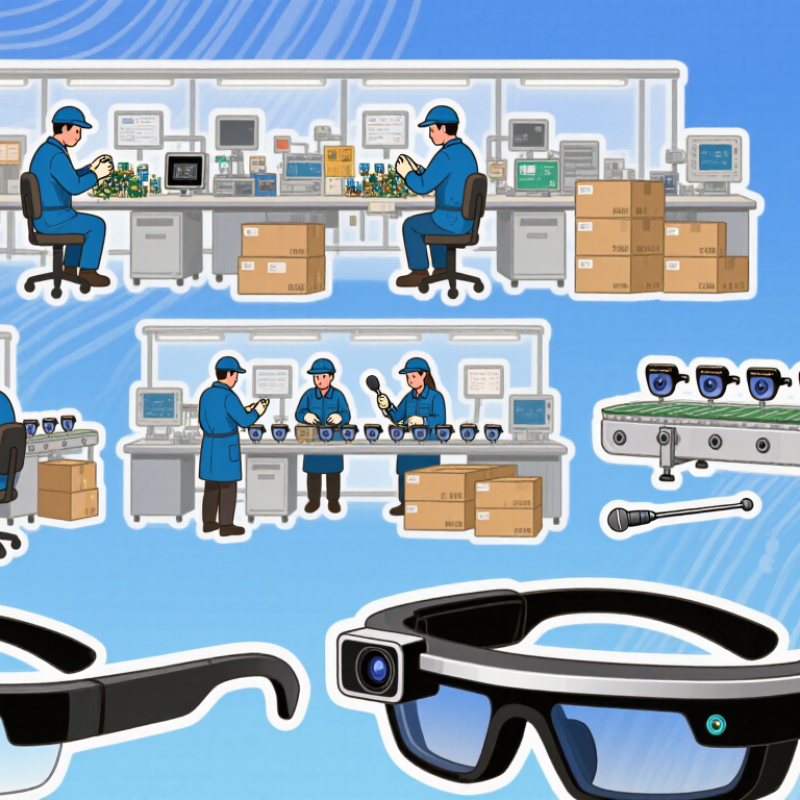
China Top Hands Free POV Video Glasses Manufacturers?

Define Hands-Free POV Video Glasses by 1080p, 30fps, and Field of View

Hands-free POV video glasses place a small camera near the wearer’s eye line. They record what the user sees while both hands remain available. For manufacturers, 1080p usually means 1920 × 1080 pixel video. This resolution keeps faces, labels, and workshop details reasonably clear. It also limits storage demand compared with higher resolutions.

Frame rate matters during movement. At 30fps, walking footage can look natural, while quick head turns may show slight blur. The result depends on shutter speed, lighting, and stabilization. Thirty frames per second is practical, not perfect. A short test in a warehouse can reveal more than a specification sheet.

Field of view defines how much of the scene appears in each frame. A narrow view feels focused but may miss nearby activity. A wider view captures more context, although straight lines can bend near the edges. Reliable manufacturers should publish the viewing angle and provide sample footage from the camera position. They should also explain lens distortion, microphone placement, battery duration, heat control, and file storage. Poor alignment can make the horizon tilt, even with good 1080p output. Small details matter. Hands-on testing remains necessary.

Hands-Free POV Video Glasses: 1080p, 30fps, and Field of View

A 1080p video frame contains 1,920 × 1,080 pixels. At 30fps, the camera records 30 frames per second, providing natural motion for everyday hands-free recording. Field of view (FOV) describes the horizontal viewing angle: 90° offers a narrower perspective, while 120° and 140° capture a wider scene. The chart uses representative FOV levels while keeping resolution and frame rate constant.

Map China’s Key OEM/ODM Hubs in Shenzhen, Dongguan, and Xiamen

China’s key OEM/ODM map for hands-free POV video glasses starts in Shenzhen. The city combines optical modules, compact cameras, wireless chips, batteries, and firmware teams. Grand View Research estimates the global smart glasses market will grow at a 27.5% CAGR from 2024 to 2030. Shenzhen suppliers can respond quickly when buyers change lens shape, camera position, or control buttons. Small pilot runs are common here. Quality still varies.

Dongguan is stronger in production discipline. Its factories support injection molding, metal frames, flexible circuits, speaker assembly, and repeated reliability testing. The China Electronics Standardization Institute emphasizes battery safety, electromagnetic compatibility, and environmental testing for wearable electronics. Buyers should inspect solder joints, hinge strength, heat around the camera, and charging-cycle results. A polished sample proves little.

Xiamen offers a different advantage. Its electronics and optical manufacturing base can support lens coating, camera calibration, audio components, and export-oriented assembly. Research and Markets identifies Asia-Pacific as the leading region for smart glasses revenue, although reports classify camera glasses differently. That weakness matters. A vendor may report “smart glasses” without separating display-free POV devices. Request monthly output, defect rates, test records, and a sample from normal production. The map is useful, but not perfect.

Compare Leading Manufacturers by 4K Capture, EIS, Storage, and Battery Life

China’s leading hands-free POV video glasses manufacturers should be compared through measured specifications, not catalog claims. IDC reported 520.5 million wearable devices shipped worldwide in 2023, showing strong demand for compact personal technology. However, video glasses remain a specialized category.

A practical shortlist should verify native 4K recording, frame rate, lens angle, and low-light detail. Some suppliers advertise “4K,” but use interpolation rather than a true 4K sensor.

That difference becomes obvious on moving streets or uneven trails.

Electronic image stabilization is equally important. Strong EIS can reduce walking vibration, but it may crop the image and weaken edge detail. Storage options usually range from 32GB to 128GB, while 4K footage can consume several gigabytes per hour.

Battery claims also need careful testing. A stated six-hour runtime may fall below four hours with 4K capture, wireless transfer, and stabilization enabled. Grand View Research identifies smart glasses as a fast-growing technology segment, yet its market projections do not replace factory-level testing.

Ask manufacturers for continuous-recording results, charging-cycle data, and waterproofing test conditions. The comparison is not perfectly clean. Temperature, firmware, and battery age can change results. In my view, a reliable supplier should provide sample footage, storage-speed measurements, and an honest performance table, even when the numbers look less impressive.

Verify CE, FCC, RoHS, and IEC 62368-1 Compliance for Global Sales

For hands-free POV video glasses, verify compliance before a sample becomes a sales promise. Ask China-based manufacturers for an EU Declaration of Conformity, reports tied to the exact model, and component-level evidence. CE marking indicates conformity with applicable EU requirements; it is not a universal quality badge. FCC requirements depend on product functions and target market. RoHS records should show the restricted-substance assessment and its scope. IEC 62368-1 covers safety for audio, video, and ICT equipment, including hazards involving batteries, charging, and accessible surfaces. Small details matter. A revised battery, lens module, or wireless board can make an earlier report irrelevant.

The European Commission’s Safety Gate 2023 report recorded 3,412 dangerous-product alerts across categories. This is not a glasses-specific failure rate, but it highlights why documentation needs traceability.

Request the report number, laboratory, tested configuration, and date. Match them against the bill of materials, product labels, charger, and firmware version. Check that reports cover the finished glasses, not merely a camera module. Ask who manages corrective action when a supplier changes a part. Paper can look complete. Sometimes it isn’t. Confirm market-specific requirements with a qualified conformity-assessment professional; CE, FCC, RoHS, and IEC evidence serve different purposes and do not replace one another.

Rank Suppliers by MOQ, 30–45-Day Lead Times, Warranty, and Defect Rates

Rank hands-free POV video-glasses suppliers using four documented measures: minimum order quantity, delivery time, warranty coverage, and defect rate. Treat a 30–45-day lead time as credible only when the supplier defines its start point, such as approved samples and confirmed components. Ask for dated schedules showing lens, camera, battery, and assembly stages. Small MOQ helps. But a low opening order can hide costly repeat-order limits.

The World Bank’s 2023 Logistics Performance Index assessed 139 economies across six areas, including shipment timeliness and logistics competence. Use it as regional context, not as proof of a factory’s performance. Request the supplier’s own on-time delivery history for the past 12 months. Deloitte and MAPI’s 2024 Smart Manufacturing Survey reported that 86% of surveyed manufacturers expected smart manufacturing to strengthen competitiveness. Ask whether production records can trace each lot and inspection result.

For ranking, assign clear weights before comparing quotations—for example, 30% defects, 25% lead-time reliability, 20% MOQ, 15% warranty, and 10% traceability. Require defect figures to state the sample size, inspection stage, and failure definition; “under 1%” means little without those details. Proof matters. Compare warranty periods, exclusions, and replacement turnaround in writing. No scorecard is perfect: pilot orders may reveal assembly issues that supplier averages miss.

FAQS

Which Chinese cities are key hubs for POV video glasses?

Shenzhen combines optical modules, cameras, wireless chips, batteries, and firmware teams. It suits flexible designs and small pilot runs. Quality still varies.

What manufacturing strengths does Dongguan offer?

Dongguan supports injection molding, metal frames, flexible circuits, and speaker assembly. Factories often perform repeated reliability testing. Inspect every hinge.

Why might Xiamen suit certain buyers?

Xiamen supports lens coating, camera calibration, audio components, and export-oriented assembly. Ask for normal-production samples, not special showcase units. The map is useful, not perfect.

How can buyers verify genuine 4K recording?

Request native sensor details, frame rates, lens angles, and original sample footage. Some devices use interpolation instead of true 4K capture. Moving scenes reveal the difference.

What should buyers know about electronic image stabilization?

Strong stabilization can reduce walking vibration during street or trail recording. However, it may crop the image and reduce edge detail. Test both effects.

How much storage is practical for 4K video?

Common storage capacities range from 32GB to 128GB. High-resolution footage can consume several gigabytes every hour. Storage fills quickly.

How should battery-life claims be tested?

Test continuous 4K recording with wireless transfer and stabilization enabled. A claimed six-hour runtime may fall below four hours. Battery age and temperature matter.

What factory records should buyers request?

Request monthly output, defect rates, test records, charging-cycle data, and waterproofing conditions. Inspect solder joints, camera heat, hinge strength, and charging results. A polished sample proves little.

Conclusion

Hands-Free POV Video Glasses are wearable cameras designed to capture first-person video while keeping both hands free. When evaluating them, start with practical specifications such as 1080p resolution, 30fps recording, and field of view, then compare higher-end options for 4K capture, electronic image stabilization, storage capacity, and battery life. China’s OEM and ODM supply base includes manufacturing hubs in Shenzhen, Dongguan, and Xiamen, where buyers can assess product development, production capabilities, and customization options.

For global sales, request documentation confirming applicable CE, FCC, and RoHS requirements, along with relevant IEC 62368-1 safety compliance. Supplier selection should also consider minimum order quantities, quoted production lead times—often around 30–45 days—warranty terms, and documented defect rates. Clear specifications, sample testing, and written quality-control procedures can help buyers compare suppliers consistently and choose products that fit their market and operational needs.

Oliver

Oliver

Oliver is a professional marketing specialist with a deep understanding of the company’s products, services, and long-term development goals. With a strong background in market research, content strategy, and customer communication, he is committed to presenting complex product information in a......