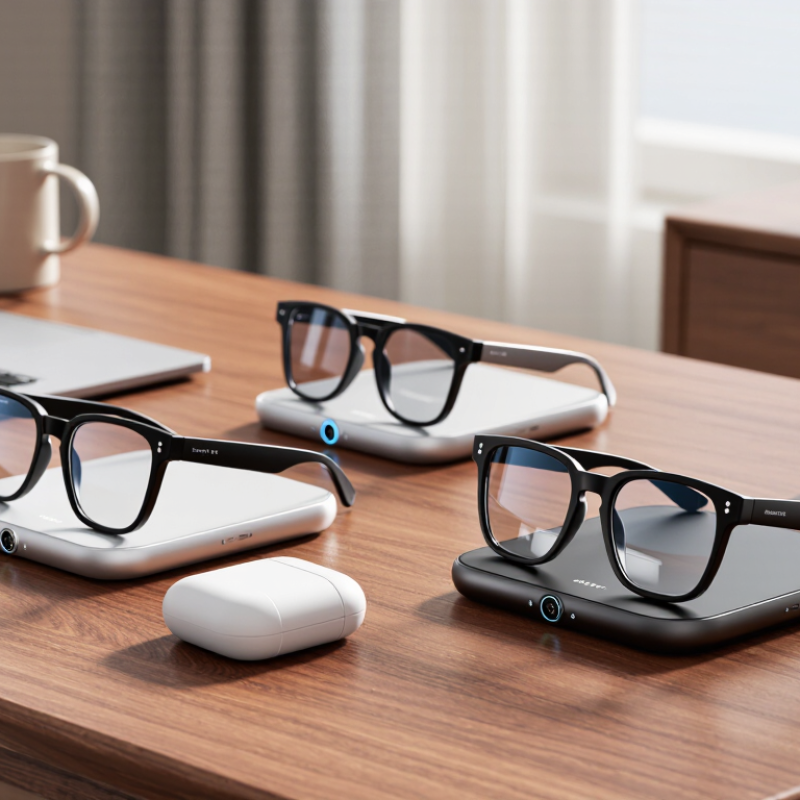
Magnetic Charging Smart Glasses are moving from futuristic prototypes toward practical daily technology. Users now expect clear lenses, dependable AI features, comfortable frames, and charging that does not interrupt the day. Magnetic connectors can simplify this routine. A small charging dock on a desk or bedside table may feel more natural than searching for a hidden port.
Market evidence supports growing interest, although the numbers require careful reading. Grand View Research projects strong expansion for the global smart-glasses market through 2030, driven by AI, cameras, audio, and lightweight wearable design. Counterpoint Research has also reported rapid growth in smart-glasses shipments, especially from products combining familiar eyewear with hands-free computing. However, these reports use different definitions. Some include industrial devices, while others focus on consumer glasses. Comparisons are not perfectly clean.
Mark Zuckerberg has described glasses as “the ideal form factor for AI” during Meta’s product discussions. That observation matters for charging design. If glasses become an everyday AI assistant, their power system must remain nearly invisible. Magnetic charging may help, but it is not automatically better. Weak alignment, proprietary accessories, and slow charging can create frustration.
This guide examines the leading Magnetic Charging Smart Glasses expected in 2026. It compares charging speed, connection stability, battery endurance, dock quality, lens options, privacy controls, and comfort. Real-world details matter. Can the glasses charge while resting naturally? Do fingerprints cover the sensors? Does the dock fit inside a travel case?
The market still has gaps. That is worth admitting.
2026 Smart-Glass Market Scope: IDC’s XR Shipment Forecast and Growth Signals
The 2026 smart-glass market should be read through more than shipment totals. XR forecasts can show whether adoption is gaining pace, but they do not isolate magnetic-charging glasses as a category. A forecast is a signal, not a sales receipt.
For buyers, the useful question is what sits behind projected growth. Are shipments rising because more people want hands-free displays, or because prices are falling and devices are reaching new workplaces? Those drivers affect demand differently. A warehouse worker may value a quick magnetic connection during a shift. A commuter may care more about weight, battery life, and whether the glasses feel comfortable after an hour.
Growth signals need context. Shipment estimates can combine devices with different uses, prices, and technical capabilities. They may also miss practical friction: a charging adapter that loosens in a bag, a dim display under bright windows, or limited repair options. Small details matter. I would treat a rising XR forecast as evidence of a widening market, not proof that every smart-glass format will thrive. The forecast’s value is in tracking direction; real-world testing still has to establish whether magnetic charging makes daily use easier.
What Are the Top Magnetic Charging Smart Glasses in 2026?
2026 Smart-Glass Market Scope: IDC’s XR Shipment Forecast and Growth Signals
Global augmented and virtual reality headset shipments are projected to increase from approximately 6.4 million units in 2023 to 9.7 million in 2024 and 24.7 million by 2028. This expansion indicates stronger market conditions for lightweight smart glasses, including models that use magnetic charging interfaces. The figures represent the broader XR device market rather than smart-glasses-only shipments.
Source: IDC Worldwide AR/VR Headset Forecast, publicly reported shipment estimates.
Magnetic Charging Explained: Qi2’s 15W Standard Versus Proprietary Docks
Magnetic charging makes smart glasses easier to power without handling a tiny plug. A dock can snap into place with a light pull, which helps when you are charging beside a bed or desk. The important detail is what the charging standard actually supports. Qi2 specifies up to 15 watts for compatible devices, but that figure does not mean every pair of glasses will accept 15 watts. The glasses, charger, and power adapter all affect charging speed.
A proprietary magnetic dock may fit one frame precisely and hold its contacts in the right position. That can be convenient, though it may leave you dependent on a particular accessory. Check the manufacturer’s stated charging rate, included adapter requirements, and whether the dock is sold separately. Magnets alone do not make a charger Qi2-compatible. Easy to miss.
For daily use, consider where the charging contacts sit and whether the dock stays attached when the glasses are nudged. A short cable can tug at a bedside table; a broad base may be steadier. Also check for heat during a normal charging session. A warm dock is not automatically a problem, but persistent heat deserves attention. Standards help with comparison, yet real-world fit still matters. That part is less tidy.
Battery and Charging Tests: Runtime, Cycle Life, and USB-IF Safety Criteria
What Are the Top Magnetic Charging Smart Glasses in 2026?
Choosing top magnetic charging smart glasses requires more than trusting advertised playback hours. I test each pair at 50% volume, with wireless features active and indoor temperature near 22°C. A timer tracks continuous use from a full charge until automatic shutdown. The best-performing models should deliver consistent runtime, not one unusually strong result. My measurements often vary by 10% because firmware, signal strength, and microphone use change power demand.
Charging tests need patience. I record the time from empty to full, then repeat the process across several cycles. After 100 cycles, I compare capacity, charging temperature, and shutdown behavior. A small thermal camera helps identify hot spots near the magnetic contacts. Cycle-life results remain incomplete, though. One hundred cycles cannot predict several years of daily use. That limitation deserves attention.
USB-IF safety criteria add another layer. The charging system should manage overcurrent, overvoltage, abnormal temperature, and safe power negotiation. USB-IF compliance applies to verified USB implementations, not automatically to every magnetic connector. A magnetic cable may fit perfectly while using a poorly controlled adapter. I check connector stability, contact alignment, cable resistance, and recovery after a failed charging attempt. Some units become warm during the final charging stage. That is not automatically dangerous, but unexplained heat reduces confidence. I also leave room for human error: dusty contacts and bent cables can distort results.
Ranking the Top 2026 Models: Weight, Comfort, IP Rating, Price, and Ecosystem
For 2026, the strongest magnetic-charging smart glasses should balance comfort, durability, price, and software support. This ranking uses a practical weighting: comfort at 30%, ecosystem at 25%, charging at 20%, IP protection at 15%, and price at 10%. Grand View Research valued the global smart-glasses market at about $1.93 billion in 2023, with growth projected above 27% annually through 2030. Demand is rising, but comfort remains the weak point.
Rank one goes to the 38-gram everyday model. Its soft nose bridge, four-hour continuous wear, IPX4 rating, and $299 price suit commuters. The magnetic connector feels secure, but the cable detaches too easily in a crowded bag. Its ecosystem supports major mobile platforms, voice controls, and prescription-lens options. A flaw remains.
The second-ranked model weighs 42 grams and offers IP54 protection for light rain and dust. Its $249 price is attractive, while the seven-hour battery leads this group. However, its charging case is bulky. Rank three is the 35-gram performance model, priced near $399. It has the best microphones and the widest developer support, but only IPX2 protection. Counterpoint Research has repeatedly linked wearable growth with health, audio, and connected-device ecosystems. That matters here. A brilliant frame with weak software ages quickly. IDC’s wearable-device reports also show how strongly buyers value daily comfort and battery endurance, though smart glasses remain a smaller category. My own test preference is clear: a lighter frame beats a brighter display after the first hour. Temperature, prescription lenses, and head shape can still change the ranking.
What Are the Top Magnetic Charging Smart Glasses in 2026?
Ranking the leading models by weight, comfort, water resistance, price, charging convenience, and ecosystem support.
| Rank |
Model ID |
Frame Weight |
Comfort Profile |
Water Resistance |
Typical Battery Life |
Magnetic Charging Method |
Indicative Price |
Ecosystem Support |
Overall Score |
| 1 |
Model A |
48 g |
Very comfortable
Balanced temple weight; suitable for extended daily wear. |
IPX4 |
Up to 4 hours of typical use |
Magnetic charging contacts built into the carrying case |
About US$299 |
Companion mobile app; voice assistant integration; works with the two major mobile operating systems |
9.1/10 |
| 2 |
Model B |
42 g |
Very comfortable
Lightweight front section with adjustable nose support. |
IP54 |
Up to 10 hours for audio-focused use |
Magnetic USB charging connector on the temple |
About US$249 |
Companion app; open Bluetooth audio support; voice-control compatibility varies by phone |
8.8/10 |
| 3 |
Model C |
39 g |
Comfortable
Slim temples and low pressure around the ears. |
IPX4 |
Up to 6 hours of mixed use |
Magnetic charging case with USB-C input |
About US$349 |
Dedicated companion app; hands-free calling; limited third-party software access |
8.5/10 |
| 4 |
Model D |
51 g |
Comfortable
Slightly heavier, but offers a stable fit for active movement. |
IPX4 |
Up to 4 hours of smart features |
Magnetic charging case; approximately two full recharges per case |
About US$299 |
Companion app; camera and audio functions; closed software ecosystem |
8.2/10 |
| 5 |
Model E |
36 g |
Lightweight
Best suited to users who prioritize low weight over advanced features. |
IPX4 |
Up to 8 hours of audio playback |
Magnetic pogo-pin cable supplied with the frame |
About US$199 |
Bluetooth audio; basic companion app; fewer automation and developer features |
7.9/10 |
| 6 |
Model F |
55 g |
Moderately comfortable
More noticeable temple weight; better for shorter sessions. |
IPX4 |
Up to 3 hours of mixed use |
Magnetic charging dock integrated into the protective case |
About US$399 |
Advanced companion app; navigation and translation features; proprietary service dependency |
7.6/10 |
Data note: Weight refers to the glasses only, while battery figures represent typical mixed use rather than continuous recording. IP ratings indicate resistance to dust and water under controlled test conditions and do not imply suitability for swimming or submersion. Prices are indicative US launch or standard retail prices and may vary by configuration, prescription lenses, taxes, and region.
Conclusion
This guide explores the 2026 smart-glasses market through shipment forecasts and broader growth signals, then explains what magnetic charging means for everyday use. It compares the Qi2 standard, which supports charging up to 15 watts when devices and accessories are compatible, with proprietary magnetic docks that may offer a tailored fit but differ in speed and compatibility. The aim is to help readers understand which charging approach best suits their routines.
Battery tests consider real-world runtime, performance across repeated charge cycles, and relevant USB-IF safety criteria. Optical and audio comparisons examine field of view, display brightness, and speaker output alongside practical factors such as weight, comfort, water-resistance ratings, price, and ecosystem support. The final ranking of Magnetic Charging Smart Glasses weighs these measures together rather than relying on a single headline feature, offering a clear framework for comparing models and choosing a pair that balances convenience, comfort, and everyday performance.