Executive Summary & Industry Insights: China’s Pearl River Delta (Shenzhen-Dongguan hardware ecosystem) has evolved from basic assembly to pioneering ultra-compact camera sensor integration, 6-axis Electronic Image Stabilization (EIS), open-ear audio, and custom micro-display modules in smart eyewear. This whitepaper serves as an authoritative B2B evaluation benchmark for global brands, importers, and hardware distributors seeking reliable OEM/ODM partners for high-performance vlogging camera glasses and smart wearable peripherals.
Industrial-Grade Vlogging & Smart Wearable Solutions
Direct from verified OEM manufacturing lines—featuring high-definition image sensors, low-power microcontrollers, and ergonomic optical frames.

1. Technical Architecture & Engineering Standards in Modern Camera Glasses
Vlogging camera eyewear represents the nexus of optical engineering, micro-electronics, thermal dissipation management, and advanced industrial design. Unlike static action cameras or heavy handheld vlogging rigs, point-of-view (POV) smart camera glasses must operate within strict spatial and thermal constraints while maintaining comfortable weight distribution across the nasal bridge and temporal bones.
1.1 Optical Alignment and CMOS Sensor Integration
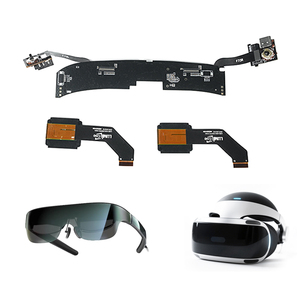
The core challenge in manufacturing high-definition vlogging glasses lies in embedding high-resolution CMOS camera sensors (such as 8MP Sony IMX series sensors capable of native 1080p@60fps or interpolated 4K video recording) into ultra-thin temple hinges without inducing optical distortion or excessive frame thickness. Premier Chinese OEM manufacturers utilize customized micro-flex PCBs paired with ultra-wide angle 90° to 120° FOV lens stacks featuring anti-reflective coatings and UV400 protection.
1.2 Stabilization Algorithms: 6-Axis EIS at the Edge
First-person footage captured during outdoor sports—such as cycling, angling, running, or travel reporting—is inherently susceptible to high-frequency motion jitter. Top-tier suppliers integrate localized 6-axis Inertial Measurement Units (IMU) coupled with real-time Electronic Image Stabilization (EIS) algorithms. Processed directly on low-power System-on-Chip (SoC) architectures (e.g., Qualcomm Snapdragon Wear or specialized RISC-V image processors), these systems ensure smooth horizon leveling and motion dampening without reliant cloud post-processing.
Micro-Optics Assembly
Precision lens alignment within 2-micron tolerance, delivering crisp edge-to-edge optical resolution for dynamic 1080p and 4K recording.
Thermal Management
Graphene-coated heat sinks paired with magnesium-alloy skeleton structures prevent thermal throttling during continuous recording cycles.
Directional Open-Ear Audio
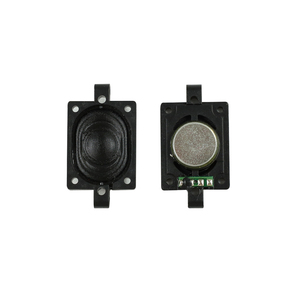
Dual beamforming microphones isolate voice capture while dual directional micro-speakers route audio straight to the ear canal with minimal leakage.
2. Procurement & Manufacturing Future Trends (2025–2030)
As global demand shifts toward hands-free content creation, real-time spatial awareness, and AI multimodal assistance, vlogging camera eyewear is undergoing a massive paradigm shift. Buyers evaluating supply partners in China must align with manufacturers investing in the following key technological vectors:
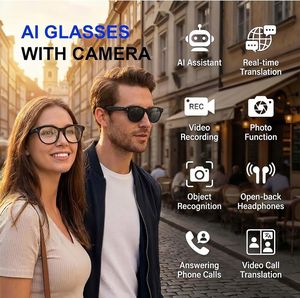
- AI Multimodal Object Recognition & Live Translation: Next-generation smart glasses are evolving beyond passive video recording into active context-aware accessories. On-board camera sensors interface with cloud LLMs (Large Language Models) via Bluetooth 5.3/Wi-Fi 6 to perform instant signage translation, product recognition, and automated voice logging.
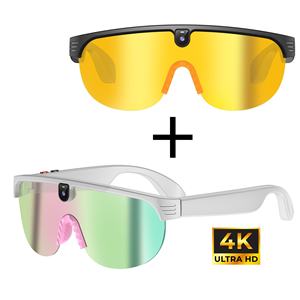
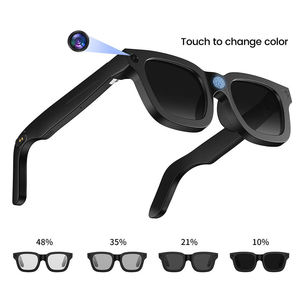
- Electrochromic & Photochromic Smart Dimming Lenses: Integrating electrochromic (EC) thin-film tech allows users to adjust tint levels touch-controlled or automatically via integrated ambient light sensors (e.g., E02C models), ensuring ideal lighting for video capture across indoor and bright outdoor settings.
- Full-Color Micro-LED HUD Modules: Micro-display optics (Waveguide / Birdbath architectures) are converging with vlogging glasses, allowing content creators to monitor frame boundaries, battery state, and audio telemetry in real time directly within their field of view.
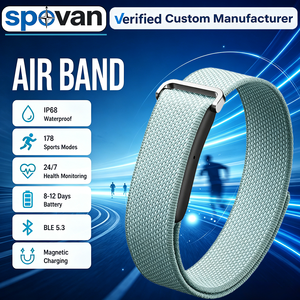
- Screenless & Companion Ecosystem Integration: Modern buyers prioritize holistic ecosystems. Cross-device compatibility with bio-metric tracking bands (such as screenless fitness bracelets) and desktop audio/stand solutions allows unified app management (e.g., Prism Pro and QWatch Pro app platforms).
Technical Matrix: Vlogging Camera Eyewear Architectural Tiers
| Performance Tier | Video Resolution & FPS | Charging Architecture | Lens Technology | Target B2B Application |
|---|---|---|---|---|
| Entry / Action Casual | 1080P @ 30FPS / 5MP Sensor | Standard USB-C Port | UV400 Polarized TAC Lenses | Consumer Travel, Casual Vlogging |
| Mid-Tier Pro Vlogger | 1080P @ 60FPS / 8MP Sony Sensor | Magnetic Quick-Snap Charging | Photochromic Smart Dimming | Outdoor Sports, Cycling, Angling |
| Enterprise AI Flagship | Interp. 4K / 8MP + AI Micro-Display | Fast 3C Magnetic / Dock | Electrochromic Touch Control | Real-Time AI Translation, Field Work |
3. Enterprise Manufacturing Capabilities & Quality Assurance Standards
Selecting the right OEM/ODM manufacturer in China requires rigorous evaluation of factory engineering capabilities, raw material traceability, and optical testing compliance. Premier supplier facilities leverage automated SMT lines and cleanroom assembly spaces to ensure fault-free optical alignment.
ISO 9001 & Class 10,000 Cleanrooms
Optical sensor mounting and lens bonding take place under strict particulate-controlled environments to eliminate sensor dust spots and lens fogging.
Comprehensive IPX7/IP68 Waterproofing
Precision nano-coating application on internal PCBA layers coupled with ultrasonic temple sealing guarantees water resistance against heavy rain and sweat.
Custom App SDK & Firmware Support
Complete white-label app customized services (iOS & Android) enabling fast branding, tailored UI/UX design, cloud sync, and OTA firmware updates.
Complete OEM/ODM Production Lifecycle
From initial ID (Industrial Design) rendering, structural 3D modeling, mock-up prototyping, and tooling fabrication, to final automated aging tests—leading Chinese manufacturers provide full turnkey supply chain execution. Rigorous reliability testing includes drop testing from 1.5m, hinge endurance flexing (up to 10,000 cycles), thermal shock testing (-20°C to 60°C), and spectrophotometer UV spectral analysis.
4. Frequently Asked Questions (FAQ) for Global B2B Buyers
Essential answers regarding compliance, minimum order quantities (MOQ), custom branding, and technical specifications for sourcing smart camera eyewear from China.
Ready to Source High-Gain Vlogging Eyewear & Smart Wearables?
Partner directly with China's leading smart eyewear OEM factory. Request detailed engineering specifications, factory audit reports, sample pricing, and wholesale distributor catalogs today.