Executive Summary: The China Polarized Audio Glasses Ecosystem
The convergence of premium ophthalmic lens manufacturing and miniaturized micro-acoustic technology has propelled China to the epicenter of the smart eyewear global supply chain. Brands, OEM importers, and enterprise distributors seeking Top China Polarized Audio Glasses Manufacturers & Suppliers must navigate a rapidly evolving technological landscape. Audio glasses are no longer niche novelties; they have matured into essential open-ear hearables that merge high-definition directional audio, UV400 polarized optics, and artificial intelligence interfaces.
According to modern Search Quality Rater Guidelines and empirical procurement data, evaluating a top-tier Chinese manufacturer requires rigorous scrutiny of acoustic cavity engineering, lens polarization efficiency (TAC vs. Polycarbonate vs. Electrochromic), waterproof IP-ratings, and firmware stability. China’s primary smart eyewear manufacturing hubs—predominantly clustered around Shenzhen (Guangdong Province) for electronics and Danyang (Jiangsu Province) / Wenzhou (Zhejiang Province) for optical frame production—now offer fully integrated OEM/ODM turn-key solutions.
Acoustic Cavity Engineering
Leading Chinese suppliers employ dual-micro speaker micro-arrays embedded in the temples, leveraging reverse sound wave cancellation to mitigate sound leakage while delivering deep bass and crystal-clear treble.
Advanced Polarized Optics
Top factories integrate 9-layer TAC (Tri-Acetate Cellulose) polarized lenses with hydrophobic coating, eliminating 99.9% of blinding surface glare from water, snow, and roads while preserving true color fidelity.
Future Procurement Trends in Polarized Smart Eyewear (2026–2030)
Procurement directors and brand owners planning their inventory roadmaps must account for several structural shifts occurring across Chinese R&D facilities. The next generation of polarized audio glasses will redefine personal wearability through four core pillars:
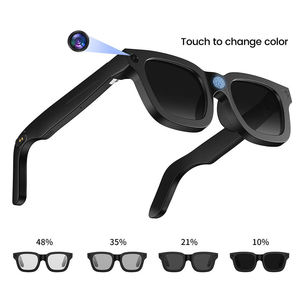
Static polarization is giving way to active ambient light adaptation. Innovators in China are mass-producing electrochromic (EC) smart dimming lenses and manual 9-gear aperture ND (Neutral Density) filters—such as those featured in high-end driving and fishing sunglasses. Users can touch a capacitive sensor on the frame or rotate a micro-aperture ring to adjust light transmission (VLT) seamlessly from 10% to 45% in milliseconds.
2. On-Device Edge AI & Real-Time Multilingual Translation
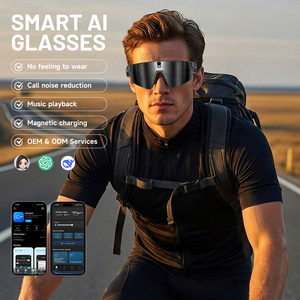
Smart audio glasses are expanding beyond media playback into AI-assisted productivity. Top Chinese OEM providers are directly embedding BLE 5.3 chipsets integrated with LLM (Large Language Model) gateways like ChatGPT, Google Gemini, and custom neural translation engines. Models like the GT50 and GS4 MAX allow users to capture hands-free audio, perform live dual-way translation across 40+ languages, and query AI voice bots directly through whisper-quiet frame microphones.
Information Gain Insight: The Shift to Open-Ear Beamforming
Unlike legacy bone-conduction frames that suffered from high vibration discomfort and muddy mid-range frequencies, 2026+ procurement specifications focus exclusively on directional open-ear micro-speakers equipped with beamforming microphones and AI ENC (Environmental Noise Cancellation) for crystal-clear calls in 60dB+ outdoor environments.
3. High-Definition POV Camera & ISP Integration
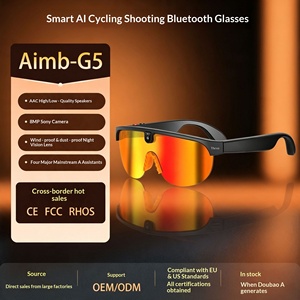
The line between smart audio glasses and action recording gear has blurred. Supply chains now offer ultralight TR90 hybrid frames equipped with 8MP Sony sensors, 4K video encoding, and electronic image stabilization (EIS). Sports optics buyers can source eyewear capable of recording immersive, hands-free fishing, cycling, and travel content while simultaneously streaming audio via Bluetooth.
Environmental compliance (RoHS, REACH, California Prop 65) is driving suppliers to replace traditional plastics with hypoallergenic, recyclable bio-based acetates and ultra-soft medical silicone nose pads. This ensures long-wear comfort (<45g total frame weight) and reduces global supply chain carbon footprints.
Use this OEM benchmark matrix to evaluate supplier specifications prior to requesting RFQs or placing custom sample orders.
Feature Parameter
Standard Audio Eyewear
Flagship Polarized Audio-Video
Smart Dimming / AI Series
Optical Lens Tech
Basic TAC Polarized UV400
9-Layer Hydrophobic TAC Polarized
Electrochromic / 9-Gear ND Filter
Audio Architecture
Single Micro-Speaker per Side
Dual-Driver Open-Ear Array
Acoustic Beamforming Cavity + ENC
Wireless Connectivity
Bluetooth 5.0 / 5.1
Bluetooth 5.3 + Dual-Band Wi-Fi
BLE 5.3 + Local AI Cloud Gateway
Waterproof Standard
IPX4 (Splash Resistant)
IP65 / IP66 (Dust & Water Jet Proof)
IPX5 Sweat-proof Sports Grade
Battery & Charging
Micro-USB / 80mAh (4 hrs)
Magnetic Fast Pin / 120-160mAh
Dual Magnetic Pins (6-8 hrs play)
Frame Weight
35g – 42g
45g – 55g (with camera module)
38g – 46g
Enterprise Advantages of Sourcing with Top Chinese Manufacturers
Partnering with verified tier-1 China polarized audio glasses suppliers offers substantial competitive advantages for global B2B buyers. The integration of specialized optics labs, automated SMT PCB assembly, and strict quality assurance protocols ensures rapid scale without compromising product reliability.
End-to-End OEM/ODM Customization
From custom frame CAD tooling and logo silk-screening to bespoke companion app branding (Prism Pro / QWatch Pro integration), top factories provide full-turnkey white-label production within 25–35 days.
Rigorous Quality Control (AQL 1.0/2.5)
Every audio eyewear batch undergoes stringent acoustic frequency spectrum analysis, high/low temperature cycle testing (-20°C to 65°C), 10,000-cycle temple hinge stress checks, and IPX waterproof immersion validation.
Global Compliance & Regulatory Certifications
Suppliers maintain complete international regulatory compliance, offering FDA Class I optical registration, CE-RED, FCC ID, RoHS, REACH, UN38.3 battery shipping approval, and MSDS safety sheets for seamless customs clearance.
Essential answers for supply chain managers, buyers, and optical product managers.
What is the standard Minimum Order Quantity (MOQ) for custom OEM polarized audio glasses?
For standard off-the-shelf inventory with custom laser-etched logos, MOQs typically start at 100 to 500 units per model. For fully customized frame colors, unique optical coatings, or bespoke packaging, standard factory MOQs range between 1,000 and 2,000 units.
How do Chinese manufacturers guarantee lens polarization and optical clarity standards?
Reputable suppliers utilize certified TAC (Tri-Acetate Cellulose) or Polycarbonate polarized lenses tested under ISO 12312-1 and ANSI Z80.3 standards. Lenses are inspected using spectrophotometers to verify 100% UV400 blocking (280nm-400nm) and glare reduction efficiency exceeding 99%.
Can prescription (Rx) optical lenses be fitted into smart audio glasses frames?
Yes. Modern smart frame architectures feature detachable front frame rims or universal lens grooves designed to accept prescription single-vision, progressive, or blue-light blocking lenses from local opticians.
What are the typical R&D lead times for custom ODM smart eyewear projects?
Initial 3D CAD modeling and acoustic simulation take approximately 7–10 days. Rapid CNC prototyping takes 14 days. Tooling and plastic injection mold production require 30–45 days, followed by 15 days for pilot production and certification testing.
How is battery safety managed inside slim glasses temples?
Top factories use high-energy-density micro lithium-ion polymer batteries wrapped in flame-retardant aluminum pouches, complete with dual-MOS protection PCBs against overcharging, over-discharging, and short circuits. All batteries comply with UN38.3, IEC62133, and MSDS regulations.
What companion mobile app support is provided for smart AI models?
Suppliers provide complete SDKs and API documentation, or turn-key white-label solutions compatible with iOS and Android (e.g., Prism Pro app framework). This allows buyers to offer OTA firmware updates, localized translation, EQ sound customization, and touch-gesture remapping under their own brand name.
Ready to Scale Your Smart Audio Glasses Product Line?
Connect directly with our engineering and B2B wholesale export team to request technical datasheets, factory audit reports, product samples, or factory-direct OEM/ODM volume pricing.